

 Ève-Lyne Marion
You've got a tech project on your hands. Or maybe you've just realized your current team needs some help. And then THE question inevitably comes up: do you hire in-house or bring in consultants?
It's a decision a lot of managers find stressful, because there's no one-size-fits-all answer. That said, there are good questions you can ask yourself before making the call.
What's your core product?
This might be the most important question. If technology is at the heart of what your company sells, an in-house team isn't really optional in the long run. Building a digital product? That's your main asset. You want that product knowledge to stay in-house, not rented out to someone else.
For a SaaS startup or a company whose product is an app, working with consultants can make sense early on to move fast. But having an in-house tech team is a question of when, not if.
Do you need something quickly?
That's where consultants have a real advantage. If you have a specific, short-term need and no time to hire and onboard someone, an external firm can fill the gap fast. You pay more per hour, but you're paying for availability and ready-made expertise.
The trap is falling into a "permanent short-term" mode. The budget isn't the same, and nobody in-house ever really gets to know your product. That can become pretty stressful, pretty fast. That said, nothing stops you from keeping consultants on while you build your team and doing a smooth, organic handoff.
What's your tolerance for turnover?
One of the less talked-about arguments against consultants is turnover. You put a project on hold, come back six months later, the same people aren't available anymore. The firm sends someone else. There's onboarding to redo.
With an in-house team, turnover happens too. But when someone leaves, the knowledge doesn't necessarily leave with them. It gets transferred. It stays in the organization.
Do you need a fresh perspective?
Sometimes the problem isn't a lack of skills, it's that you've had your nose too close to the same issue for too long. A pair of outside eyes, even for a short time, can shake things up and help you see the problem from a new angle. In that context, consultants can make all the difference.
Independent consultant or consulting firm?
When we say "consultants," we often lump everything together. But hiring an independent consultant is very different from working with a firm.
With an independent, you generally pay less, but you're managing them yourself. You need to know what to ask for, evaluate their work, and handle the relationship. If it's not a good fit, that's on you to deal with.
With a firm, you pay more, but you're also paying for management. It's their responsibility to send you the right people, replace someone who's no longer available, and deliver what was agreed on. For a manager without a lot of technical background, that difference can be worth its weight in gold.
Do you have a very specific, well-defined problem?
There are highly qualified experts in very specific niches. If you've got a one-time problem that's out of the ordinary, skipping that expertise to save money in the short term is trading short-term savings for long-term headaches.
 The decision isn't always binary.
A lot of organizations operate with a core in-house team that handles day-to-day work and product knowledge, and brings in consultants for specific needs or peak workloads.
That model can be very effective, as long as someone in-house is capable of coordinating both sides. When it's well orchestrated, you get the best of both worlds.
A visual to help you think it through
We put together a visual that summarizes the three main models and their key advantages. Sometimes seeing things side by side helps you pinpoint what actually matters for your situation.
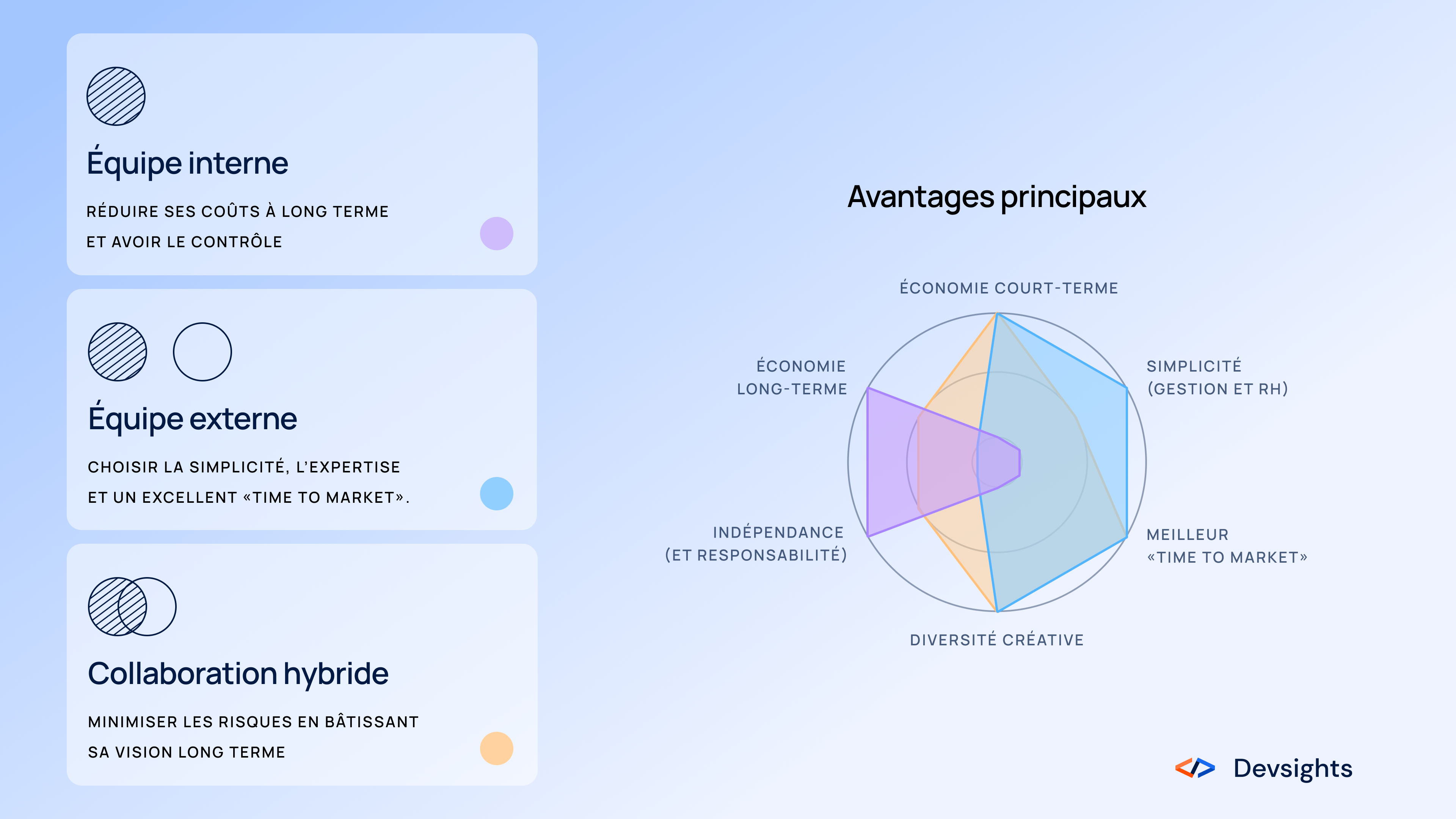
In-house team, if you're looking to reduce long-term costs and keep control. External team, if you want simplicity, expertise, and a strong time to market. Hybrid collaboration, if you want to minimize risk while building your long-term vision. No wrong answer, just different contexts.
In the end
Consultants or in-house, it's rarely just a budget question. It's a question of context: where you're at, what you're building, what you want to grow. Take the time to ask the right questions. The answer is already there, you just need to let it surface.
We talked through all of this in detail in Episode 5 of Code 18. If you've got an hour, it's worth a listen.
Ève-Lyne Marion
May 12, 2021 • tests
No testing, too much testing, right on target

December 10, 2020 • devops
A DevOps Journey - The beginning

December 10, 2020 • news
Because we have to start somewhere
May 12, 2021 • tests
No testing, too much testing, right on target
December 10, 2020 • devops
A DevOps Journey - The beginning
December 10, 2020 • news
Because we have to start somewhere
Want to discuss?
Do you have a digital project idea we could help you with? Do you just want to discuss or have questions? Don't hesitate to contact us, we'll be happy to respond!

Or write to us at info@devsights.com


With financial participation from:

©2026 Devsights | Website designed by Devsights